
Wildlife & Nature of Ha Long Bay
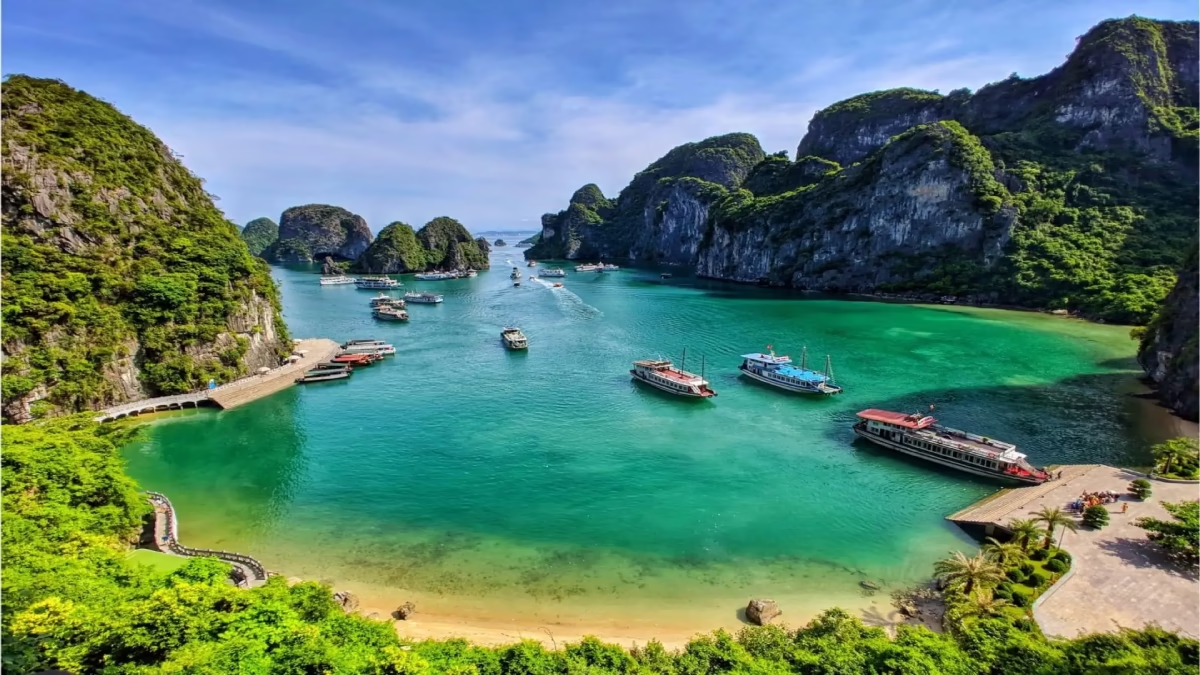
Ha Long Bay’s UNESCO World Heritage inscription covers not only its geological value but also its biological diversity. The bay supports more than 1,000 species of marine invertebrates, 160 species of coral, 500+ species of fish, numerous bird species, and several rare mammals including the critically endangered Cat Ba langur. The marine ecosystem is under significant pressure from boat traffic, pollution, and overfishing — but the bay retains remarkable biodiversity, much of it visible to cruise passengers without specialist equipment.
Ha Long Bay is famous for its geology — but the geological landscape supports a biological world of equal complexity. The karst islands create sheltered lagoons and micro-habitats that harbour species found nowhere else. The water column from surface to seabed supports a complete marine food web. And the islands themselves — particularly those with forest cover — are home to mammal, reptile, and bird communities that have evolved in relative isolation for thousands of years.
This guide covers what you are likely to see on a cruise, what to look for, and the conservation context that frames the bay’s natural significance.
Ha Long Bay Marine Life
Fish
Ha Long Bay supports more than 500 species of fish across a range of habitats — shallow coral reef zones, the open water column, and the deep channels between islands. Species commonly encountered by snorkellers and visible near the waterline in clear conditions include grouper, sea bass, snapper, damselfish, and small reef fish associated with the rocky island bases.
The fish visible during kayaking are typically small reef-associated species, skimming around the limestone cliff bases and in the shallow sheltered areas. Grouper and cuttlefish — the commercially valuable species cultivated in the floating village fish farms — are also visible in the floating cages, giving cruise passengers their closest encounter with local aquaculture.
What to look for from the boat: Schools of small fish breaking the surface in feeding frenzies (particularly at dawn and dusk), jumping fish in open water, and the shadows of larger fish visible in shallow clear water near the islands.
Jellyfish
Jellyfish are a significant presence in Ha Long Bay’s waters, particularly during warmer months (April to October). Several species are present, ranging from small moon jellyfish (Aurelia aurita, harmless) to larger species capable of causing skin irritation.
Practical significance for swimmers: Before entering the water, ask your guide whether jellyfish are present. Guides monitor conditions and can advise on current concentrations. If jellyfish are present in significant numbers, swimming stops may be relocated to a different cove.
Coral
Ha Long Bay has more than 160 species of hard and soft coral distributed across the bay’s rocky submarine surfaces. Coral coverage is denser in the outer bay areas (Bai Tu Long, Lan Ha Bay) where water quality is higher and boat traffic lighter. In the central bay zone, years of intense boat traffic, anchor damage, and water quality degradation have reduced coral coverage significantly.
Squid
Squid — the target of the evening squid fishing activity on overnight cruises — are present in Ha Long Bay’s waters year-round. The LED squid lights used on cruise boats mimic bioluminescent organisms that attract squid to feed at the surface. Common species include the bigfin reef squid (Sepioteuthis lessoniana).
Birds of Ha Long Bay
Ha Long Bay’s karst islands support a range of resident and migratory bird species, including several raptors that nest on the island cliff faces. White-bellied sea eagles, ospreys, and peregrine falcons are the most impressive avian residents — visible from the boat deck when perching on cliff tops or soaring on thermals above the limestone towers. Terns, herons, and egrets are common throughout the bay’s sheltered waters.
White-bellied sea eagle (Haliaeetus leucogaster) — the most spectacular bird visible from cruise boats. A large raptor with a distinctive white head, chest, and tail, often seen perching on karst pinnacles or in broad soaring flight over the water. Excellent eyesight — they spot fish from altitude and dive to take them from the surface.
Osprey — another fish-hunting raptor, slightly smaller than the sea eagle. The osprey’s dramatic feet-first plunge into the water to take fish is occasionally visible from the boat deck in the early morning.
Egrets and herons — large wading birds present throughout the bay. The great egret (Ardea alba) and grey heron (Ardea cinerea) are common near the island shorelines and floating village fish farms.
Terns — several tern species nest on the bay’s more remote islands. The black-naped tern (Sterna sumatrana) is a characteristic Ha Long Bay species.
Kingfishers — the common kingfisher (Alcedo atthis) and the white-throated kingfisher (Halcyon smyrnensis) are both present in the bay’s sheltered waters, often visible as a flash of blue-orange near the waterline.
Best time for birdwatching: Early morning — the period between sunrise and 9:00am when birds are most active and boat traffic is lowest. Overnight cruise guests on the sun deck at dawn have the best birdwatching conditions.
Mammals of Ha Long Bay
Cat Ba Langur (Trachypithecus poliocephalus)
The Cat Ba langur is one of the world’s rarest primates — with a population of approximately 60 to 70 individuals confined to Cat Ba Island and its immediate surroundings, it is classified as Critically Endangered by the IUCN. The species is endemic to the Cat Ba archipelago and has no other natural population. It is white-headed with a golden-orange body and is primarily arboreal, living in the limestone karst forests of Cat Ba National Park. Sightings from cruise boats are rare but possible near the island’s forest margins.
The Cat Ba langur is one of Vietnam’s most significant wildlife conservation concerns. Hunting and habitat loss reduced the population from several thousand to fewer than 100 individuals over the 20th century. Conservation programmes including the Cat Ba Langur Conservation Project (operating from Cat Ba Island) have stabilised the population. Travellers visiting Cat Ba Island on multi-day cruises or the Ha Long Bay Cruise from Cat Ba may spot langurs near the forest edges of the national park cliffs.
Other Mammals
Wild boar (Sus scrofa) — present on several of Ha Long Bay’s larger forested islands, though rarely seen from cruise boats.
Civets and pangolins — historically present on the larger islands; populations have been significantly reduced by hunting and habitat pressure.
Dolphins — infrequent but documented visitors to Ha Long Bay’s outer areas. Indo-Pacific humpback dolphins and finless porpoises have been recorded in the bay and adjacent waters.
Ha Long Bay Plant Life and Island Ecology
Ha Long Bay’s karst islands support a range of vegetation types adapted to the extreme conditions of thin limestone soils, steep terrain, and salt spray. The islands’ vegetation falls into several zones:
Mangrove forest — fringing the island bases at the waterline, mangroves stabilise the shoreline, provide fish nursery habitat, and absorb wave energy. Ha Long Bay’s mangrove coverage has been reduced by development but remains significant in the outer bay areas.
Tropical karst forest — the interior of larger islands supports dense subtropical forest with species adapted to the thin, calcium-rich soils of limestone terrain. These forests are poorly accessible from the standard cruise routes but visible as green canopy covering the island summits.
Pioneer vegetation on cliff faces — the vertical limestone walls support specialised plant communities — mosses, ferns, and succulents — that colonise the rock faces using moisture from fog and rain, creating the biological crust visible on older karst surfaces.
Ha Long Bay Conservation and Environmental Pressures
Ha Long Bay’s ecology is under sustained pressure from several sources. Boat traffic — with more than 500 licensed cruise vessels plus local fishing and ferry boats — generates noise, fuel spillage, and anchor damage. Plastic pollution from tourist activities and local sources is visible in the central bay. Overfishing has depleted the wild fish populations that historically sustained the floating village communities. Climate change threatens the bay’s coral and the integrity of the karst formations through sea-level rise and increased storm frequency.
What you can do as a visitor: – Use the refuse bins provided on your cruise boat — do not throw anything overboard – Bring a reusable water bottle — most cruise boats have refillable water coolers – Avoid single-use plastic packaging when packing for the cruise – Support operators with environmental certifications or green tourism accreditations – Avoid buying coral or shell products in Ha Long City souvenir shops — these are taken from the bay’s living reef
The Ha Long Bay Management Board has implemented several conservation measures including anchor-free zones in sensitive areas, waste management requirements for licensed operators, and aquaculture regulation. The challenge of managing an enormously popular natural site at sustainable visitor volumes remains ongoing.
Frequently Asked Questions
What animals can you see on a Ha Long Bay cruise?
The most commonly sighted wildlife from cruise boats includes white-bellied sea eagles, ospreys, egrets, herons, kingfishers, and terns. Marine life visible in the water includes schools of reef fish, jellyfish, and (during evening squid fishing) squid near the surface. The Cat Ba langur is visible only on Cat Ba Island with specific effort.
Are there sharks in Ha Long Bay?
Shark attacks in Ha Long Bay are exceptionally rare and sharks are not a meaningful safety concern for swimmers. The bay is relatively shallow, heavily trafficked, and not typical shark territory. Small reef-associated shark species are present in the outer bay areas but are rarely encountered by cruise passengers.
Are there crocodiles in Ha Long Bay?
No wild crocodiles live in Ha Long Bay. The Siamese crocodile — once present in some Vietnamese coastal habitats — is now extinct in the wild across northern Vietnam.
Is the water in Ha Long Bay clean enough to swim in?
Water quality varies significantly by zone. The outer bay areas (Lan Ha Bay, Bai Tu Long Bay) have cleaner water with better visibility and less boat traffic contamination. The central bay zone around the main cruise corridors has reduced water quality due to boat fuel, sewage, and plastic pollution. Operators use designated swimming coves that avoid the worst contamination.
Is Ha Long Bay a UNESCO World Heritage Site for wildlife or geology?
Both. Ha Long Bay was inscribed on the UNESCO World Heritage List for outstanding universal value in two categories: geological and geomorphological values (the karst formations), and natural beauty. The biological diversity contributes to the site’s overall significance, and the outstanding geological value explicitly encompasses the living ecosystems of the karst landscape.
Can I snorkel on a Ha Long Bay cruise?
Basic snorkelling is occasionally included on some cruise itineraries, particularly those accessing the cleaner outer bay waters of Lan Ha Bay or Bai Tu Long Bay. Standard day cruise and overnight cruise programmes do not usually include snorkelling equipment. If snorkelling is important to you, confirm availability with the operator when booking.
