
Top Islands & Karst Formations in Ha Long Bay
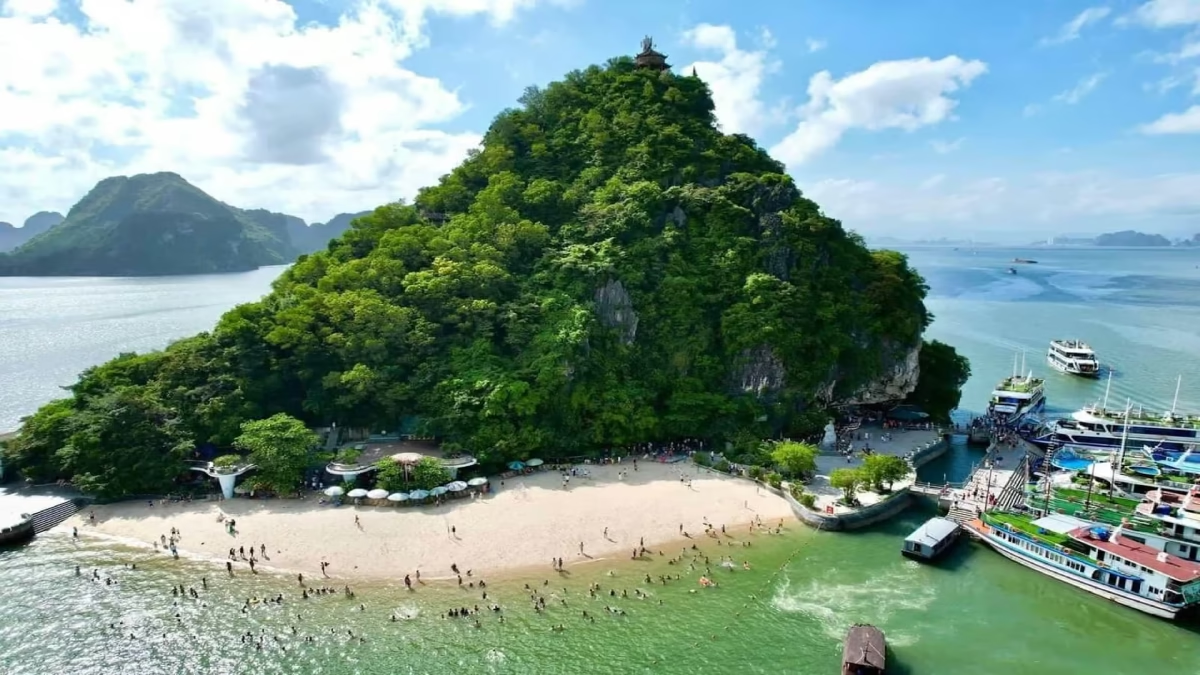
Ha Long Bay contains more than 1,600 limestone karst islands and islets, ranging from towering single rocks rising vertically from the sea to complex island groups with beaches, caves, and lagoons. The most visited and famous include Ti Top Island (beach and panoramic summit viewpoint), Sung Sot Cave island (largest cave in the bay), the Fighting Cocks formation (the bay’s most photographed rock pair), Dau Go Island (Wooden Stakes Cave), and the Vung Vieng and Cua Van floating villages. Most cruise itineraries cover two to four of these landmarks.
The limestone karst formations of Ha Long Bay are 500 million years old — the product of ancient seabed limestone elevated by tectonic forces and then sculpted by 20 million years of erosion, dissolution, and sea-level change. The result is one of the most visually complex natural landscapes on the planet. This guide covers the most significant islands and formations — what each one is, what makes it worth visiting, and which cruise formats give you the best access.
Ti Top Island on Ha Long Bay
Ti Top Island is the most visited island on Ha Long Bay for tourists. It has a small curved beach, a concrete stairway of approximately 400 steps climbing to a summit viewpoint, and one of the best panoramic views of the bay’s central karst zone. The summit panorama is reproduced in more Ha Long Bay travel photographs than almost any other vantage point. The island is named after Soviet cosmonaut Gherman Titov, who visited with President Ho Chi Minh in 1962.
The Ti Top Island visit has two components: the beach and the summit. The beach is small — a 200-metre crescent of white sand with calm, sheltered water — but the setting makes it extraordinary: limestone karsts rising on three sides, the bay stretching beyond. The summit climb takes approximately 20 minutes up the concrete stairway and rewards with a 360-degree panoramic view across Ha Long Bay’s central zone that is genuinely difficult to describe to someone who has not seen it.
Best for: First-time visitors, photographers, and families with older children (the climb is manageable from age six or seven with supervision).
Included on: Most overnight cruises, the Halong Bay Cruise with Sung Sot & Ti Top Island, and many day cruises.
Tip: Go early in the morning or in the late afternoon — the summit view in midday light is flat and harsh. The same viewpoint in early morning mist or late afternoon gold light is transformative.
The Fighting Cocks Formation (Gà Trống và Gà Mái)
Two towering limestone pillars rising side by side from the water — commonly called the Fighting Cocks formation — are the most iconic non-cave image of Ha Long Bay. They appear in virtually every wide-angle photograph of the bay’s central zone and are used on much of Vietnam’s tourist promotional material. The formations rise approximately 20 metres from the water surface and stand close enough together to appear to be leaning toward each other.
Most cruises pass these formations during transit without a dedicated stop. The best viewing angle and photography conditions are from water level on a kayak or from the bow of the cruise vessel in the early morning.
Best for: Photographers and first-time visitors wanting the “iconic Ha Long Bay” image.
Access: Visible from most central bay cruise routes without a dedicated stop.
Sung Sot Cave (Surprise Cave) — Đảo Bồ Hòn
Sung Sot Cave is Ha Long Bay’s most famous cave system and is located on Bồ Hòn Island. Discovered in 1901 by French geologists and named for the surprise of its vast interior, the cave has two chambers: a modest entrance chamber that gives no indication of what follows, and a second chamber reaching approximately 10,000 square metres — large enough to contain a small village — with stalactites up to 20 metres tall.
The cave is lit with coloured lighting that divides opinion aesthetically but makes the formations clearly visible. The guided walk takes 20–30 minutes. For more on Ha Long Bay’s caves including Sung Sot, see Caves to Explore in Ha Long Bay.
Included on: The Halong Bay Cruise with Sung Sot & Ti Top Island specifically names it. Many other overnight cruises visit Sung Sot as their primary cave stop.
Dau Go Island (Wooden Stakes Cave — Hang Đầu Gỗ)
Dau Go Island contains one of the largest accessible cave systems in Ha Long Bay. Its name derives from the sharpened wooden stakes that Trần Hưng Đạo allegedly stored here in the 13th century before his naval victories against Kublai Khan’s Mongol fleet — one of the bay’s most significant historical associations.
The cave has three chambers with high ceilings and varied stalactite formations. It receives fewer visitors than Sung Sot and is consequently quieter — one of the advantages of operators who use it over the more famous alternatives.
Best for: Travellers interested in the geological and historical depth of the bay’s cave landscape.
Soi Sim Island and Its Pink Flowering Shoreline
Soi Sim Island is smaller and less famous than Ti Top but notably beautiful in a quieter way — a hillside covered in sim (rhodomyrtus tomentosa) — the wild rose myrtle — that flowers in pink across the island’s slopes for much of the year. The island has a small beach and a short hiking trail to a modest viewpoint.
It appears on some day and overnight cruise itineraries as a swimming and beach stop alternative to Ti Top. Less crowded, less dramatic, and genuinely pretty.
Ha Long Bay Karst Geology: Why It Looks the Way It Does
Ha Long Bay’s limestone formations were created over approximately 500 million years. The process began as marine sediment accumulated on an ancient seabed and compressed into limestone. Tectonic uplift exposed this limestone to the surface approximately 300 million years ago. Rainwater — slightly acidic from dissolved carbon dioxide — then began dissolving the limestone over millions of years, creating caves, arches, and the isolated towers and islands visible today. The current bay formed as sea levels rose following the last Ice Age approximately 10,000 years ago, flooding a formerly terrestrial karst plain and leaving only the highest towers above water.
This geological process — called tropical karst or tower karst — produces formations that are distinct from the rolling karst hills of inland limestone regions. In Ha Long Bay, the towers rise almost vertically because the dissolution occurred from all sides simultaneously, leaving isolated pillars rather than ridges. The result is the vertical-wall, flat-water landscape that distinguishes Ha Long Bay from other limestone regions.
Three main formation types you will see from the boat:
- Isolated towers (fenglin karst) — single rocks rising vertically from the water, no land connection. The most dramatic visual element of the bay.
- Connected island groups — clusters of towers connected at the waterline or via beaches, often with accessible interiors including caves and lagoons.
- Arched formations — rock arches created when caves near the waterline eroded through to the other side. Kayak routes commonly pass through these arches.
Lan Ha Bay: The Less-Visited Extension
Adjacent to Ha Long Bay to the south, Lan Ha Bay contains more than 300 islands with the same limestone karst geology but significantly fewer tourist boats. Many of Lan Ha Bay’s islands have white sand beaches accessible only by kayak or small boat — entirely absent from the central Ha Long Bay zone where water depth and boat traffic make beaches impractical.
For cruises that access Lan Ha Bay, see Ha Long Bay to Lan Ha Bay Cruise and Ha Long Bay 2-Days Cruise.
Bai Tu Long Bay: The Remote Northeast
Northeast of the central Ha Long Bay zone, Bai Tu Long Bay is the outermost section of the UNESCO World Heritage Area. With far fewer licensed cruise operators routing this way, it offers the geological drama of Ha Long Bay with a fraction of the boat traffic. The Overnight Bai Tu Long Cruise and 3 Day Ha Long Bay Cruise both access this area.
Frequently Asked Questions
How many islands does Ha Long Bay have?
Ha Long Bay contains approximately 1,969 islands and islets in total, of which around 1,600 are within the UNESCO World Heritage Zone. The vast majority are uninhabited limestone karst formations.
What is the most famous island in Ha Long Bay?
Ti Top Island is the most visited by tourists due to its combination of beach and panoramic summit viewpoint. The Fighting Cocks formation is the most photographed. Sung Sot Cave island (Bồ Hòn) is the most famous for its cave system.
How old are the limestone formations in Ha Long Bay?
The limestone that forms the karst towers was originally deposited as marine sediment approximately 500 million years ago. The karst dissolution and tower formation process has been ongoing for around 300 million years. The current bay formed approximately 10,000 years ago when rising sea levels after the last Ice Age flooded the karst plain.
Can you visit the islands independently without a cruise?
The interior of Ha Long Bay — including the named islands, caves, and formations — requires a cruise or guided boat tour to access. The national park fee and boarding system mean independent access by private boat requires separate arrangements. For most travellers, a cruise is the practical and recommended access method.
What is the difference between Ha Long Bay and Lan Ha Bay karst formations?
Geologically identical — the same limestone, the same formation processes, the same tower karst architecture. The difference is access and visitor numbers. Lan Ha Bay is less visited, has more beaches accessible by kayak, and is generally quieter. Ha Long Bay’s central zone has the most famous named formations (Ti Top, Fighting Cocks, Sung Sot) but also the most boat traffic.
